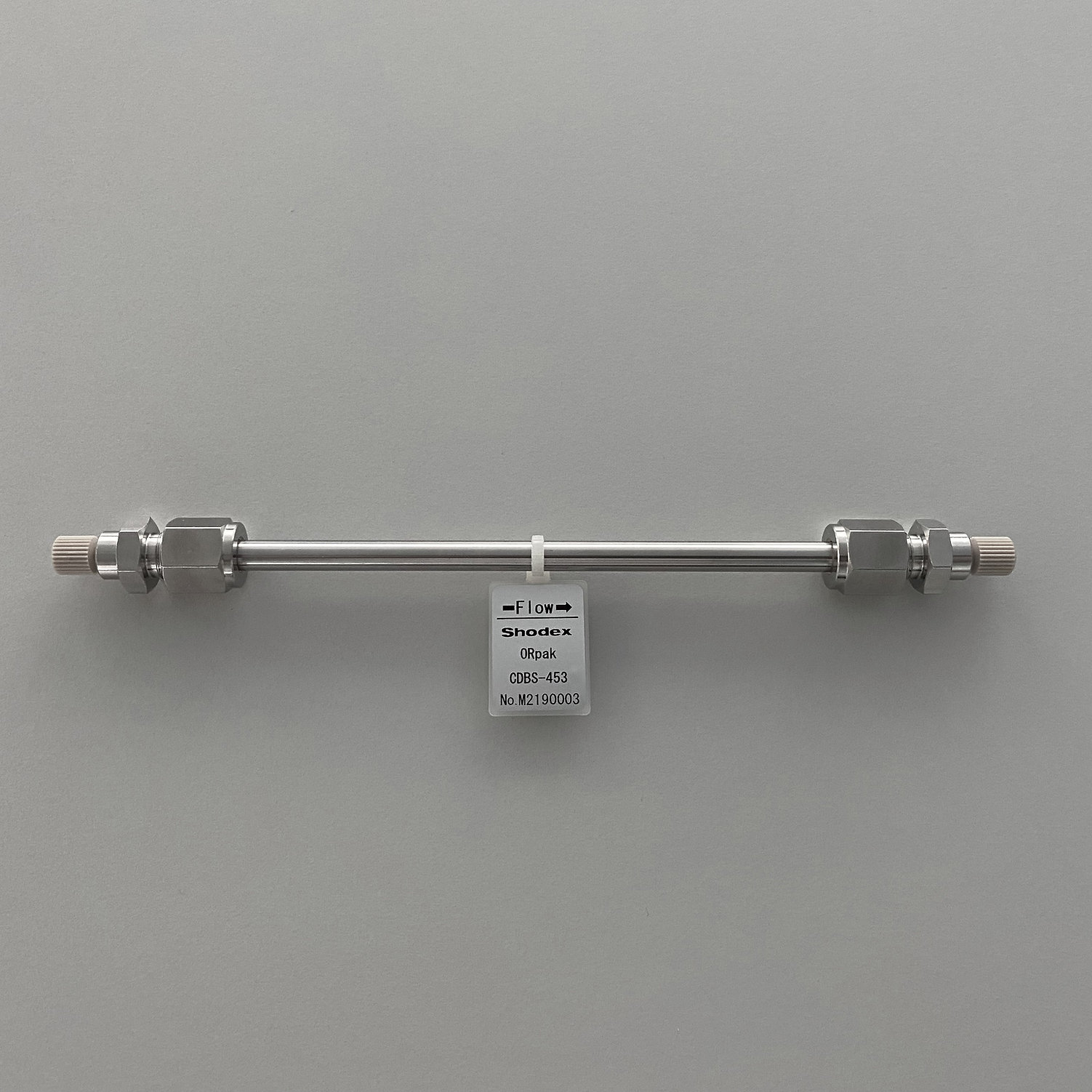
Shodex Ion-Exchange and Ion-Exclusion HPLC Columns
Shodex ion-exchange and ion-exclusion chromatography columns provide a comprehensive solution for the high-precision separation of carbohydrates, organic acids, ionic and neutral compounds, and biomolecules. Shodex polymer-based columns provide long service life, excellent reproducibility and stable operation for routine testing as well as analyses in research and regulated environments.
Ligand-exchange chromatography columns– Ligand Exchange Chromatography Columns
Shodex ligand-exchange HPLC columns achieve separation through a combination of the ligand-exchange mechanism and, in some cases, size-exclusion or HILIC effects. As a result, they provide excellent selectivity and resolution, even for analytes with very similar structures.
Ligand exchange + size-exclusion columns
These columns are primarily suitable for separating mono-, di- and oligosaccharides, as well as polysaccharides. For many types, pure water is sufficient as the eluent, enabling straightforward method development and stable detection.
Key benefits:
- separation of sugars using ligand exchange + size-exclusion mechanisms
- aqueous eluent only for certain types
- excellent reproducibility
- suitable for routine testing and standard methods
Typical applications:
- glucose, fructose, sucrose, maltose
- lactose, lactulose
- oligosaccharides, starch hydrolysates
- biomass and fermentation samples
Ligand exchange + HILIC columns
The combination of ligand-exchange and HILIC mechanisms enables the effective separation of neutral and slightly ionic sugars and sugar alcohols using eluents that also contain organic solvents.
Benefits:
- improved selectivity for complex sugar mixtures
- broader method development options
Applications:
- saccharides and sugar alcohols
- taurine and related compounds
- food additives (e.g. sweeteners)
- Columns suitable for pharmacopoeial methods
Several Shodex ligand-exchange column types are for USP, JP and EP pharmacopoeial methods validated, making them an ideal choice for analyses in regulated environments and quality-control testing.
Typical applications:
- sorbitol, mannitol, maltitol
- lactose and related sugars
- pharmaceutical excipients
- QC and validated analytical methods
Shodex Ion Exclusion chromatography columns
Shodex Ion Exclusion chromatography columns have been specifically developed for the reliable separation of organic acids, sugars, sugar alcohols and alcohols. The ion-exclusion mechanism is particularly effective for analysing weak acids and neutral components where ion-exchange or reversed-phase techniques do not provide satisfactory results.
Key applications:
- organic acids
- sugars and sugar alcohols
- fermentation samples
- wine, beer and other food products
- alcohols and residual solvents
- glycerol, glycols, furan derivatives
Benefits:
- stable operation with acidic eluents
- effective with isocratic methods
- ideal for routine analyses and validated methods
Shodex Ion Chromatography columns – anion analysis
Shodex ion chromatography columns designed for anion analysis are widely applicable to the determination of inorganic and organic anions in drinking water, environmental samples and industrial water. The columns are available for both suppressed and non-suppressed systems.
Components that can be analysed:
- fluoride, chloride, bromide, iodide
- nitrate, nitrite, sulphate, phosphate
- oxyanions
- organic acids and their derivatives
Technical features:
- rapid analysis
- consistent peak shape even at low concentrations
- compatible with drinking-water and environmental analysis standards
Shodex Ion Chromatography columns – cation analysis
Shodex ion chromatography columns for cation analysis provide a reliable solution for separating alkali and alkaline-earth metals, ammonium, amines and transition metals.
Typical applications:
- sodium, potassium, calcium, magnesium
- ammonium ion
- alkyl and organic amines
- amino alcohols
- industrial and environmental samples
Benefits:
- excellent selectivity for monovalent and divalent cations
- good peak separation even at high salt concentrations
- rapid analysis
Contact us, and we will help you choose!