Colony Counters and Inhibition Zone Readers
Manual, automated and AI-based solutions for microbiology laboratories
Accurate and reproducible colony counting and reliable evaluation of inhibition zones in antimicrobial susceptibility testing are key steps in microbiological testing.
Our range includes everything from manual colony counters to fully automated, AI-assisted systems, enabling us to recommend a suitable solution for every laboratory requirement.
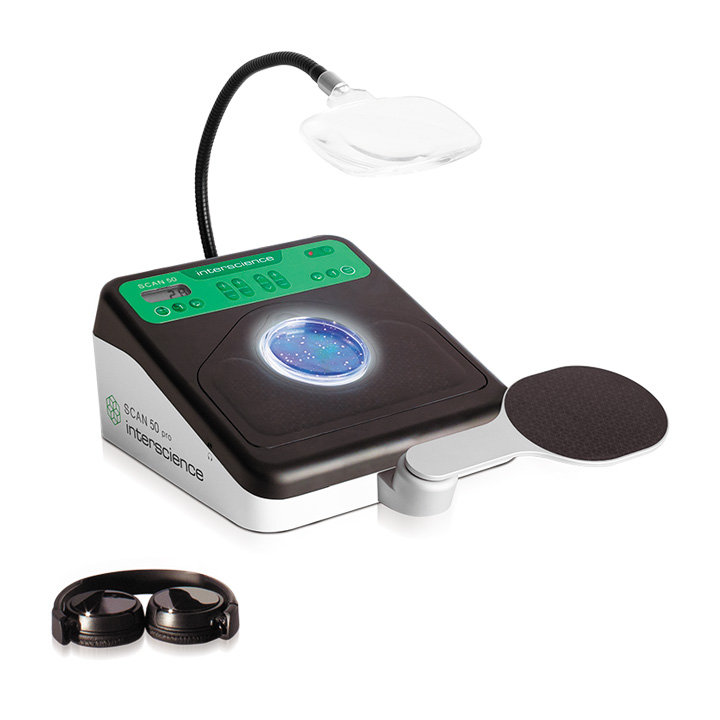
Manual colony counters
- Simple, fast and cost-effective solutions
- Manual colony counters are ideal for low sample volumes, teaching laboratories or routine testing where quick visual assessment and ease of use are the main priorities.
Typical applications:
- Food and water testing
- Teaching and demonstration purposes
- Routine measurements with low to medium sample volumes
Advantages:
- Simple, ergonomic operation
- Well-lit work surface
- Reliable and durable
- Low capital cost
These instruments enable rapid manual counting without requiring a complex software environment.
Automated colony counters and inhibition zone readers
Faster evaluation, greater reproducibility
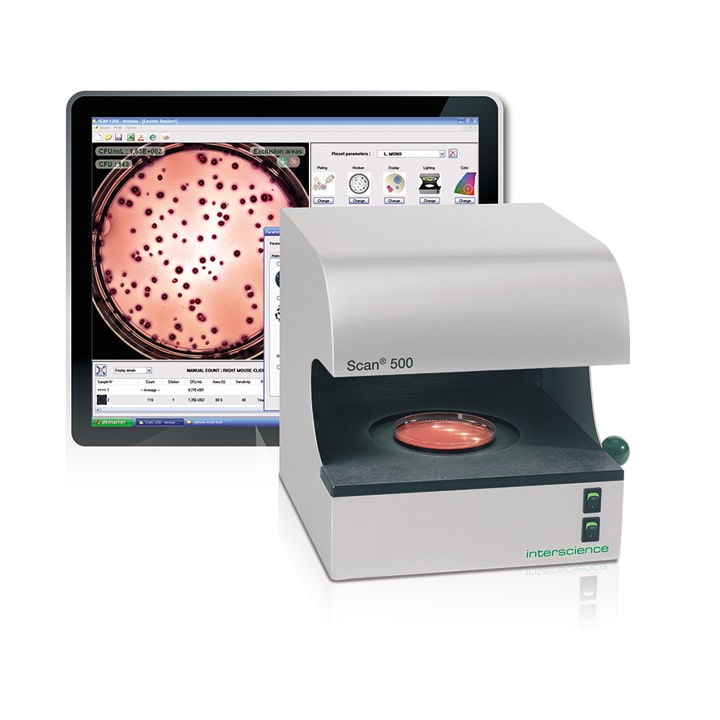
Automated colony counters significantly reduce operator subjectivity while increasing throughput and measurement accuracy. The systems can be used both for colony counting and for measuring inhibition zones in antimicrobial susceptibility tests.
Benefits:
- Automated image processing
- Fast, repeatable results
- Documented, retrievable data
Recommended applications:
- Quality control laboratories
- Food industry and environmental testing
- Routine measurements with medium to high sample volumes
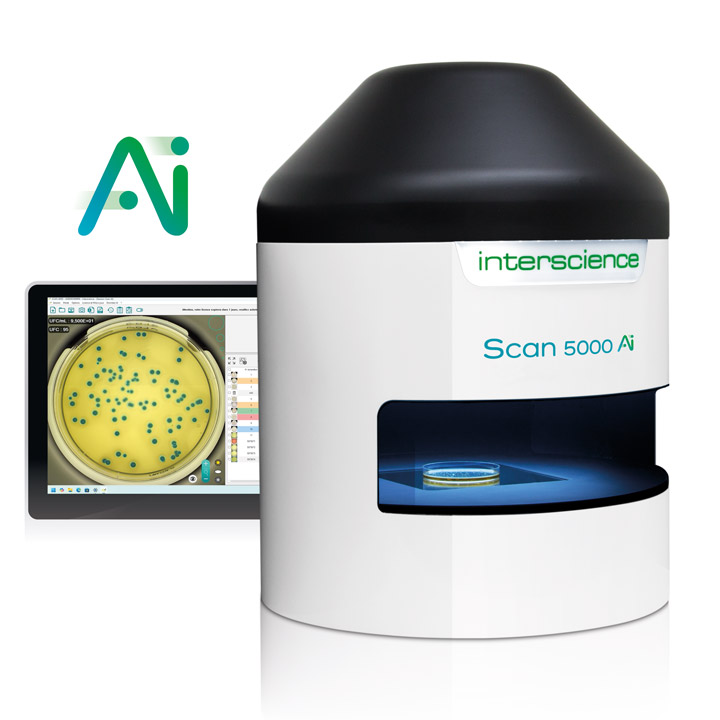
AI-based colony counters and inhibition zone readers
Artificial intelligence for maximum accuracy
AI-based systems use state-of-the-art image-processing algorithms capable of reliably detecting colonies with different morphologies, overlapping colonies and varying background conditions.
Why AI?
- Minimal user intervention
- Extremely high detection accuracy
- Automatic evaluation of complex samples
- Time savings with high sample volumes
Ideal choice for:
- Accredited laboratories
- Measurements in research and development environments
- High-throughput testing
- Standardised, documented and auditable measurement processes
AI-based systems are particularly useful where consistency and documentation are especially important.
Selecting the right colony counter depends on several factors:
- Sample volume, test type
- Documentation requirements
- Level of automation
- Budget
The website presents automated and AI-based colony counting systems.
Two types of manual colony counter are also available in the product range, although they are not listed separately on the website.
Get in touch, and we will help you choose!
Available models:
Automated colony counters and inhibition zone readers
| Scan 300 | Scan 500 | Scan 1200 |
|---|---|---|
| Brightness, contrast and sensitivity are automatically optimised by the software | ||
| Long-life LED lighting | ||
| CMOS colour camera, 28× zoom, M12 lens | HD colour CCD camera, 28× zoom, Japanese HD lens | |
| Minimum detectable colony size: 0.1 mm |
Minimum detectable colony size: 0.05 mm |
|
| – | Detects and counts up to 7 colours on the same plate | |
| – | Inhibition zone reading using EUCAST, CA-SFM, CLSI and an editable database | |
| – | – | Reading of Petrifilm™, Compact Dry™, MC-Media Pads™, Easy Plate TM and membrane filters |
| Results can be exported to your computer and archived in ExcelTM, PDF, SCA or BIO format Images can also be exported from the camera in JPEG, PNG and BMP format |
||
General specifications
| Feature Model | Scan 300 | Scan 500 | Scan 1200 |
|---|---|---|---|
| LIMS/SIL connectivity | ✓ | ✓ | ✓ |
| USB connectivity | ✓ | ✓ | ✓ |
| DataLink/DataLink Pro traceability system available |
✓ | ✓ | ✓ |
| Automatic counting | ✓ | ✓ | ✓ |
| Counting on chromogenic plates | – | ✓ | ✓ |
| Inhibition zone reading | – | ✓ | ✓ |
| Automatic separation of clustered colonies |
✓ | ✓ | ✓ |
| Counting time | Up to 1000 colonies per second | ||
| Petri dish size | Ø 55 mm – Ø 90 mm | ||
| Warranty | 3 years | ||
| Compliance | 21 CFR part 11, ISO 7218 and AOAC 977.27 | ||
| Licence type | Perpetual | ||
AI-based colony counters and inhibition zone readers
| Feature Model | Scan 3000 Ai | Scan 5000 Ai |
|---|---|---|
| LIMS / SIL connectivity | ✓ | ✓ |
| USB connectivity | ✓ | ✓ |
| Detailed, full traceability | ✓ | ✓ |
| Counting on surface-, spiral- and circular-spread Petri dishes | ✓ | ✓ |
| Counting on chromogenic media | ✓ | ✓ |
| Petrifilm™, Compact Dry™, MC-Media Pad™, EasyPlate™ | ✓ | ✓ |
| Contact plates (RODAC®, Biocap™, Hycon™) | ✓ | ✓ |
| Automatic colony counting | ✓ | ✓ |
| Inhibition zone evaluation | ✓ | ✓ |
| AI-based automatic colony counting | ✓ | ✓ |
| Counting mode | Automatic + manual correction (add / delete) | |
| Automatic separation of merged colonies | ✓ | ✓ |
| Classification of bacteria, yeasts and moulds | ✓ | ✓ |
| Counting speed | Up to 1000 colonies/second | |
| Minimum detectable colony size | 0.03 mm | |
| Antibiotic disc detection | Automatic, with manual correction | |
| Antibiogram support | ✓ | ✓ |
| Antibiogram compatibility | CLSI, EUCAST, SFM, CA-SFM, Clinical Laboratory Standards Institute | |
| Inhibition zone measurement accuracy | ±0.2 mm | ±0.1 mm |
| Camera/Lens | Ultra HD CMOS/Japanese HD lens | |
| Zoom | x 69 | |
| Resolution | 5 MP | 12.2 MP |
| Compatible Petri dish size | Ø 55-90 mm | Ø 55-150 mm 120 mm square |
| Data security/compliance | 21 CFR part 11, ISO 7218, AOAC 977.27 | |
| USB data export | ExcelTM, CSV, PDF, PNG, JPG | |